
Stephanie Gharakhanian ’07 is comfortable in liminal spaces.
She’s always balanced two distinct cultural identities. A first-generation American, Gharakhanian is the daughter of an Iranian father and an Italian mother, which gave her empathy for others living between cultures. And that led her to El Paso, Texas, at the southern border of the United States, where she worked first as a member of the Jesuit Volunteer Corps and then at Annunciation House, an organization that offers hospitality to immigrants and refugees.
“I was really drawn to the U.S.-Mexico border, in part, because of my own experience being a child of immigrants and wondering what it was like to be in a place that is known as between cultures, in that way,” she says. “My parents had a very different immigrant experience than the folks I was working with once I moved to the border. But what I really resonated with was, growing up, our house was always this interesting blend of the different places that my parents came from and, of course, where we were living at the time. I just really loved that in-betweenness, and I could see that in El Paso, too.”


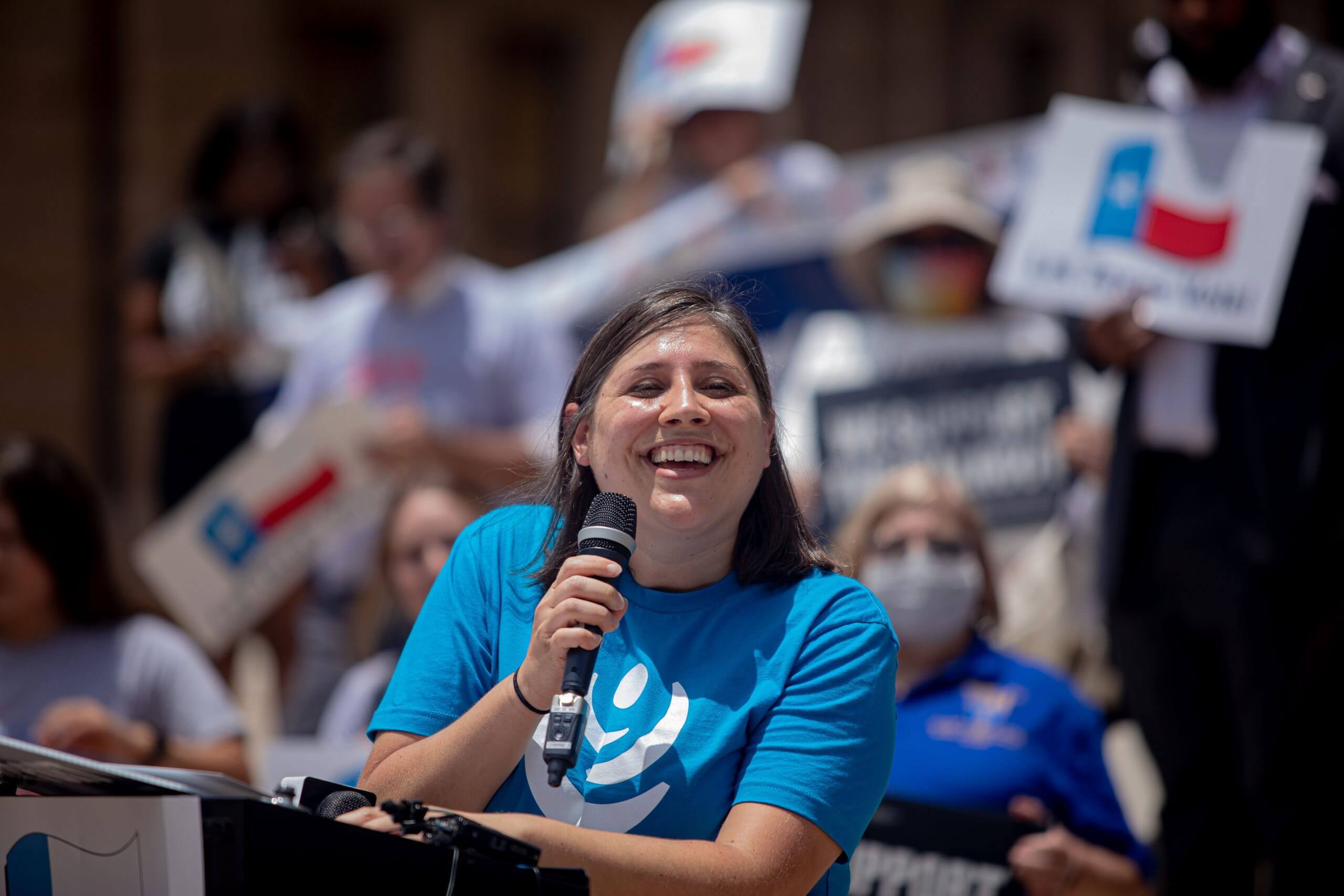


Today, Gharakhanian still lives in Texas, and she’s dedicated to supporting workers, immigrants, and refugees as they navigate those types of intermediate spaces. Now she’s in Austin and works for her county district attorney’s office, prosecuting work-related crimes. She’s mom to two young kids with her partner, Nick. And she’s a trustee of the Austin Community College District, focused on supporting both students and employees at Austin Community College.
It was a path she did not necessarily foresee when she enrolled at Notre Dame to study science on a premed track.
“In retrospect, I wanted to do something that was service-oriented, but I just didn't have, at that stage in my life, enough models of the many different ways that that could happen,” she recalls. “And I think medicine was a very visible and noble helping profession that I had encountered at that stage, and that I was drawn to for that reason. But I loved the peace studies coursework that I was doing.”
After getting involved with the Center for Social Concerns (now the Institute for Social Concerns) and meeting a number of peace studies majors, Gharakhanian decided to take a few courses. Eventually, she added international peace studies as a double major with science preprofessional studies. After participating in a Summer Service Learning Program (SSLP) in rural Georgia and an international SSLP in Cambodia, she decided to join the Jesuit Volunteer Corps (JVC) after graduation.
That’s where, in El Paso, she found the role models she was looking for in service-oriented careers beyond medicine.
“Through my experiences in JVC and at Annunciation House, I started to meet attorneys who really inspired me,” Gharakhanian says. “I had never really encountered lawyers in real life or through popular culture that reflected a career path that was appealing to me. But I got to meet those folks and was really inspired by them to pursue a degree in law.”
Gharakhanian grew up in Connecticut and returned to New England for law school at Northeastern University in Boston, but always knew she wanted to return to Texas. She’s lived in Dallas and Austin since moving back to the Lone Star State, advocating for workers’ rights as an attorney. She started out at Workers Defense Project, a nonprofit organization that provides support to low-wage workers, eventually serving eight years as its director. There, she campaigned for higher wages and safer jobs for Texas workers.
Gharakhanian says that ability to make an impact is what she enjoys most about her work. After seeing people struggle with the limitations of the immigration system, she was inspired by the potential to make a difference within labor law.
“It was inspiring to see people who had experienced labor abuses on the job who became involved in the worker center, and who took really courageous action to stand up to an employer and demand their rights and win,” she says. “Seeing a community gather around the person impacted and collectively offer their support was like nothing I’d ever seen before. And seeing how the attorney was involved in that—it is a really unique model of lawyering that is rooted in not just getting a result for a client, but in building collective power and consciousness.”
Outside of her current job prosecuting work-related crimes for her county DA’s office, Gharakhanian also serves the Austin Community College District as a trustee, a role she’s held for the past six years. She compares it to a school board role, but for community colleges. She plugged into the community college world in Austin community members she met at the worker center, many of whom had taken continuing education or English classes at one of the 12 community college campuses in her district. Gharakhanian works with her fellow trustees to pass the district’s budget, oversee vision and strategy, and supervise the chancellor, the head of the Austin Community College District.
“What really drew me to the community college movement is its similarity to workers’ rights,” she says. “It’s a public institution that is all about encouraging and supporting economic mobility in our community. I think about community colleges the way I think about libraries and post offices—these are precious public institutions that should be nurtured and protected. Our community colleges exist to make sure that our community has an affordable, accessible pathway to workforce training and higher education.”
Gharakhanian is someone who knows her values and lives by them. And those values are rooted in Catholic Social Teaching and what she learned through her Center for Social Concerns and peace studies experiences at Notre Dame, supported by the community of friends she found there.
“I can’t overstate the importance of those relationships in my life and the support, accountability, and clarity that community has continued to offer and gift to me,” she says. “One of the biggest gifts that came from my time at Notre Dame was this robust community of people who share values. We continue to engage with each other and try to see each other as often as we can, even at this stage in our lives when we are scattered across many different places. I feel deeply that they are people who have helped me stay true to my values and nurtured me in the work that I have continued to do since Notre Dame.”


