
A golden glow in a child’s eye can be easily dismissed as a trick of the light by the camera flash in the annual Christmas card. But for some families, it is the first sign of a life-altering diagnosis. When Megan Webber ’90 saw that glow in photos of her son, she unknowingly stepped into a much larger fight against pediatric blindness.
Webber’s experience revealed that the difference between early detection and irreversible vision loss hinges on a fragile pathway to care—how quickly a concern is recognized, whether resources are available, and whether medical providers are informed enough to spot the warning signs.
As Webber took pictures of her young children growing up, she noticed that in every 100 pictures, her son Ben’s left pupil would glow “like a gold coin.” During a family trip with her sister, Kara Ciocca ’93, Ciocca spotted Ben’s glow in her pictures, and recalled reading that the phenomenon could be a sign of eye cancer. Alerted by her sister’s concerns, Webber brought her camera along to Ben’s next pediatrician appointment. Though five-year-old Ben did not complain or show any signs of vision challenges or deficits, when the pediatric ophthalmologist covered his right eye, Ben’s left eye could not read the big letter “E” just a few feet away.


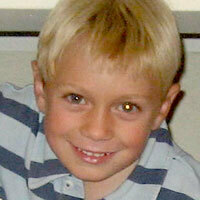


After being referred to Children’s Hospital Los Angeles (CHLA), specialists determined that Ben did not have retinoblastoma—the most common form of intraocular cancer found in children—but did have advanced-stage Coats Disease. This rare, unilateral eye condition is attributed to abnormal leaking blood vessels behind the retina, leading to a slow retinal detachment over time, and is most commonly found in boys under 10.
Ben underwent laser surgery to seal the leaking retinal vessels and a patching treatment. The patch covered his dominant eye to train his brain to exercise the weaker, affected eye. Ben now retains some vision in his left eye, though mainly only peripheral vision.
After Ben’s diagnosis, Webber began writing letters seeking large donations to fund critical equipment at CHLA for treating Coats Disease. Following one of these outreaches to friend Lanette Turicchi, the two reconnected and Turicchi encouraged her to pivot to asking for thousands of small donations while also building awareness along the way.
“She and I hadn’t spoken for at least three years before then, but she said, ‘I feel compelled to call you. I think we’re supposed to do this.’”
Webber then dove deeper into her ocular research, learning that leukocoria—or “the glow” visible in photographs—can indicate an array of underlying diseases, from more critical diagnoses like retinoblastoma to more common conditions like amblyopia, or “lazy eye.”
But there was a gap in resources available for supporting and educating families dealing with these diagnoses. Though Webber graduated from Notre Dame with a degree in psychology with a concentration in business, she did not always plan to enter nonprofit work—or to lead an organization of her own. But that didn’t stop her and her husband, Brian, from taking action.
“It was pretty clear: if we didn’t do this, who was going to do this? If we didn’t know this was something to watch for, how are other parents going to know?” she explained. “Along the way, we were meeting so many families that weren’t having our experience. Their children were losing one eye, losing both eyes, or were desperate to come to the U.S. to try to find someone to treat their child once it had become more advanced.”
So, Webber put together an initial awareness campaign to educate and look for the glow that would later grow into the nonprofit she co-founded with Turricchi and Sandra Roderick. Know The Glow is now a leading global nonprofit raising awareness of leukocoria and fighting to prevent childhood blindness. She launched the Know The Glow website and featured real stories of family members and other loved ones who first caught the glow that led to their child’s diagnosis. Quickly, Webber and Know The Glow partnered with non-governmental organizations and realized there was great need beyond the borders of the United States.
“One day, I had an alert about a parade happening in Mumbai, and I looked at some of the signs they were carrying and you can even see that they wrote ‘Know The Glow’ on their signs, and they were using the images and phrases from our website.”
In response, Webber and her team created graphics with messages translated into several languages to disseminate information more effectively across a wider range of countries and communities. Today, Know The Glow’s awareness campaigns have been translated into nearly 50 languages and have reached 26 countries, with doctors and NGOs in 10 additional nations who are interested in partnering with the organization. The global nonprofit leader now has over 50 partners worldwide, including large NGOs and smaller local nonprofits.
Recently, Know The Glow has triangulated efforts with the Arclight Project and World Eye Cancer Hope to expand access to Arclight devices and training. Developed by optometrist and engineer William J. Williams and ophthalmologist Dr. Andrew Blaikie out of the University of St. Andrews, the portable, solar-powered ophthalmoscopes use built-in light and lenses that connect to a smartphone to act as a screen—enabling earlier detection of eye diseases and bridging the critical gaps in the pathway to care. Additionally, training sessions provide life-saving care, particularly to the overlooked 0-to-5 age range in underserved countries.
Within her Notre Dame community, Webber and Know The Glow have partnered with Barbara Calhoun, the Reisenauer Family Director for Patient Advocacy Education and Outreach at Notre Dame, to encourage student volunteers to share resources with local groups during their semesters abroad through collaborative advocacy. Some students are undergraduates pursuing careers in medicine, while others are accounting and marketing majors.
“Students are a huge help,” Webber shares. “As we move into each nation, they help us research: who are the doctors there? What is happening within that country, in terms of how it supports children with pediatric vision disease?”
While Notre Dame sponsors Know The Glow’s first student chapter, there are seven additional university chapters that have followed, offering ideas, creating outreach efforts, and organizing three events annually to build classroom, campus, and community awareness. From Snapchat filters to participating in video trends to engage with patient families through social media, students have been contributing fresh ideas to help families find their children’s diagnoses one TikTok at a time.
From conferences in Chicago and Kenya to Zoom meetings with Bangladesh’s Minister of Health, Webber credits students’ commitment and insight with helping connect the organization to a global audience. This March 2026, Webber attended the International Society of Ocular Oncology Conference in Rio de Janeiro to speak at a retinoblastoma workshop and also served as an advisor to the St. Jude Global team in developing their early detection toolkit instruction.
In addition to student chapters, several ophthalmologists, oncologists, and academics—including Dr. Carol Lally Shields ’79, the Director of the Ocular Oncology Service at WillsEye Hospital—have joined Know The Glow’s Medical Advisory Board to promote awareness and education within the field of professional medicine.
“It is exciting to see the way patient advocacy is impacting not only the families themselves, but even supporting these oncologists. As many children die from late diagnoses as die from treatment abandonment,” Webber reveals. “Patient advocacy is assisting to support these doctors by building a network of parents around them to encourage staying the course of treatment and to show that there is a light at the end of the tunnel.”
Today, Webber describes Know The Glow as a “family affair,” with her sister Kara serving as community outreach manager and Notre Dame students and staff forming an extended network of support.
“Fast forward and now Ben is getting ready to graduate from Notre Dame. He has been able to play sports, drive a car, do all of the things that you want your child to do,” Webber shares. “But, I could have never dreamed of what would come to be, and how Know The Glow would be able to play a role in the worldwide focus on trying to help find children who don’t know yet they need to be found.”


