
One laugh is all it took. One laugh and Jimmy Brogan ’70 was hooked on comedy — a career where he finds his own happiness in bringing it to others. But his path to Hollywood, writing for and performing on some of the largest stages in comedy, was far from linear.
Though he grew up not far away from South Bend in Cleveland, Notre Dame was not always a lifelong dream for Brogan. He stumbled into a love for Notre Dame after visiting with a friend for a football weekend.
“I went out for a football game, and it was the greatest weekend I’d ever seen,” Brogan said.
Likewise, he stumbled into his major in sociology.
“My undergrad major was sociology, and the reason was because my roommate made out my schedule every year and he was a sociology major,” Brogan said. “I had no plan. I had no idea that you could get into show business.”
For Brogan, comedy was an adopted outlook on life — if one was not a top athlete or a scholar, having a sense of humor was a good third option. He carried this outlook throughout his time at Notre Dame, yet turning that sense of humor into a career didn't seem like an option.
Unsure of what path to take after undergrad, Brogan enrolled in Notre Dame’s MBA program before switching to education counseling.
“I did one semester towards an MBA. And thought, ‘Oh, this is not for me,’” Brogan said. “And so I switched to education counseling, and I thought, ‘Oh, okay, this is closer. It's dealing with people, and I’d be a high school guidance counselor.’ But, you know, I would have been telling kids to go to clown college. Like, oh, you know, you could go to William and Mary. But how about Barnum and Bailey?”


Eventually, in his second year of grad school, Brogan’s indecision mounted.
“They finally kicked me out after six years (at Notre Dame),” Brogan said. “The day they kicked me out was like the worst day of my life. I thought, ‘This is horrible. You know, all I’ve ever done is go to school, and I’m not even good at that!’ But, it opened a path for me to start doing stand-up, and that changed my life.”
But before giving him this final push towards comedy, Notre Dame also gave Brogan his first laugh.
“The first time I ever got up in front of the crowd, it was part of An Tostal,” Brogan said.
As a member of the original An Tostal committee, Brogan suggested an impersonation contest. When Brogan was tasked with hosting the event, he didn't think much of it.
“I thought it’d be five kids under a tree (participating in the contest), and we would give out a ribbon to the winner,” Brogan said. “The day of the contest was right after lunch, and they had somehow gotten a portable stage and a PA system and set it up on South Quad, there in front of Alumni Hall. And I had to emcee this thing, and all of a sudden there were 1,000 kids sitting on South Quad waiting for whatever this was going to be.”
During the event, Brogan eventually fell into a rhythm. When University President Rev. Theodore Hesburgh, C.S.C. ’39 walked past the event confused by the crowd, Brogan saw an opportunity to poke fun and suggest it might be another priest impersonating Father Hesburgh.
"And it actually got a laugh — not the greatest in the world — but it got a laugh,” Brogan said.
He soon learned that one laugh can spark a dream.
“Based on that one laugh, when I went to New York, I remember sitting on the Greyhound bus and thinking, I wonder if they have comedy clubs there and I could get more laughs,” Brogan said. “And so just based on that one experience at Notre Dame, getting that one laugh gave me the idea that maybe I could do stand-up.”
New York City presented both triumph and obstruction towards Brogan’s pursuit of comedy. But, perhaps above all, it presented opportunities.
After his first stand-up performance with his friend Larry Lee ended in crickets, Brogan sought the expertise of comedian and TV personality Dick Cavett’s 1974 book, Cavett. However, working as a volunteer in the city at the time, Brogan could not afford the $8.95 hardcover.
“So my father had asked me to drive his car to Florida for the winter. My parents had just started going to Florida, and so I drove his car. I had a certain budget for that, and I slept in the car in North Carolina to save money so I could buy Dick Cavett's book,” Brogan said. “So I went to Florida, bought Dick Cavett's book — $8.95 hardback — and wrote my first original stand-up about going to an intellectual high school.”
Little did Brogan know, he would eventually go on to share the stage with Cavett.
“Eight years later, it was my first appearance on The Tonight Show with Johnny Carson. The guest right ahead of me is Dick Cavett, and he does his segment, and then I come out and do my stand-up, and I thanked him afterwards for his book, for getting me started,” Brogan said. “It was the perfect first appearance.”
Yet the path to that moment on stage in Los Angeles took grit. Brogan recalls his 4 a.m. stage slots, often playing for one table.
“I would take the subway back to Brooklyn and get home as the sun was coming up. You know, it was a tough going in those early days. But I made sure that I got on stage as much as I could,” Brogan said. “In the first year, I probably did maybe 100 shows. The second year, maybe 200 shows. And then, by my third year in comedy, well, I did 1,000 shows that year. … Sometimes I would do six shows a night.”
Eventually, those 4 a.m. appearances turned into 1 a.m. shows, and seats started filling up. But, Brogan looks back on those single-table nights in gratitude for helping him find his style.
“I was getting on, as I said, late at night, and playing to one table, so I had to make it more conversational than a bigger crowd,” Brogan said. “Eventually that talking to the audience became funnier than the material.”
The audience knows authenticity. Under the stage lights, a comic can be no one but themselves. So, perhaps it was knowing his style, or knowing himself, that gave Brogan the voice to answer Hollywood’s call.
“I was doing stand-up at the Comic Strip in New York. And one of the waitresses, Hillary Rollins, her father was a comedy manager — the biggest manager in show business at that time,” Brogan said. “And she said to me one night, ‘I’m thinking about becoming a manager, and I would like to bring my dad in to see you and a few others.’ And I said, ‘Oh, great.’ The other comics were Jerry Seinfeld, Larry Miller, and Larry David.”
After the show, talent manager Jack Rollins talked to the comics. Brogan absorbed his advice, but didn’t think much of the meeting after that.
“And then, about two weeks later, Hillary took me aside. And she said, ‘You know, my father is so disappointed in you.’ And I said, ‘What?’ And she said, ‘Yeah, you didn’t ask him to manage you.’ And I said, ‘Oh, I didn’t know that’s how it worked!’ So he then became my manager,” Brogan said.
Producers, screen tests, and a pilot followed. All of a sudden, Brogan found himself moving to Los Angeles to star in the ABC sitcom, Out of the Blue.
“It was an unbelievable change,” Brogan said. “I remember walking on the Paramount lot with my friend Mike Cain, who was my good comedy friend from New York, and I said to him, ‘Can you believe we’re on the Paramount lot and no one’s chasing us?’”
This disbelief faded as he found his new home in Hollywood. Soon, through his friend Jerry Seinfeld, Brogan met Jay Leno.
“I knew Jay from the clubs, and really more through Jerry than anything. We would go to Jay’s house and hang out late at night and talk comedy,” Brogan said. “Jay had started six years before me. So, you know, he was like an older brother to us, comedywise.”
This late-night joke exchange turned into the dream job.
“When Jay took over [The Tonight] Show, he said, ‘Oh, if you want, you could do the same thing for me, help me just put together the monologues.’ And I said, ‘Sure, I'll do it for six months to get you started.’ And it ended up being nine years,” Brogan said.
Looking back on where comedy has taken him, Brogan offers the advice: “Figure out what you love and see if you can make a career out of it.”
“It’s been the greatest gift to me that I ended up being in New York when there were comedy clubs, and developing this gift of a little sense of humor that I had. … I mean, my freshman year in Stanford Hall, there were probably 100 funny guys. Just in my section, there were probably five guys funnier than me,” Brogan said. “But, I guess that one laugh at Notre Dame was enough to think, ‘Oh, maybe I could be a stand-up comedian.’ As foolish as that sounds, that one moment changed my life.”
Now, Brogan is working on a screenplay with his Notre Dame roommate, Dave Edmonds ’70.
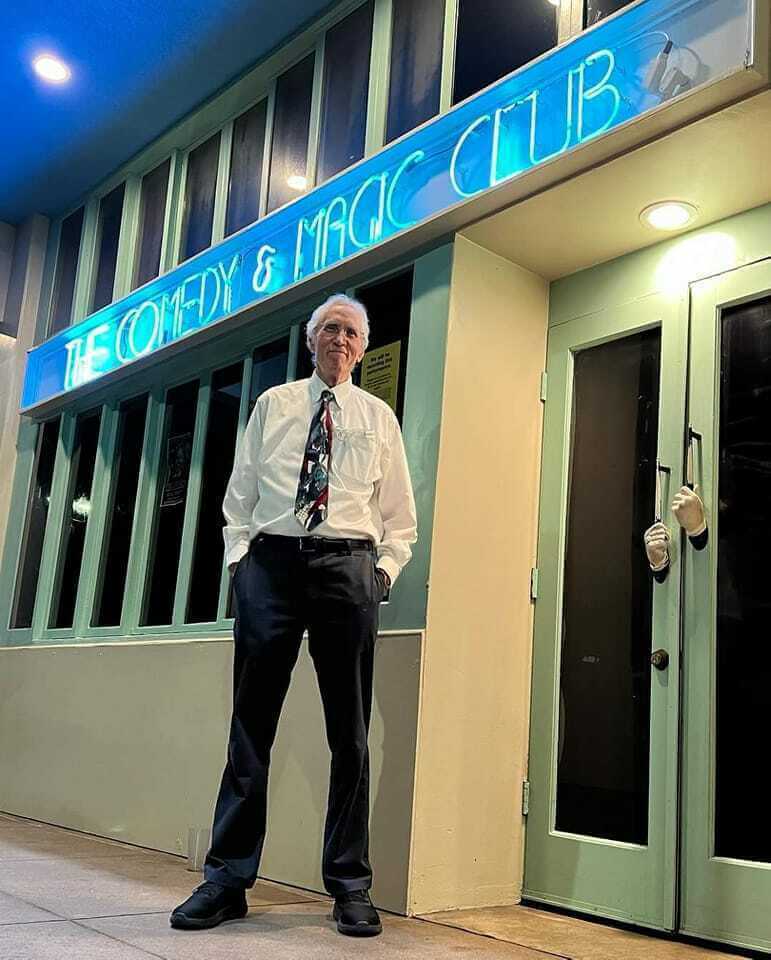
He still does stand-up comedy on the weekends, opening for Leno at The Comedy & Magic Club in Hermosa Beach, California, every Sunday night for 32 years.


